
%402x.svg)
Surprise Proposal Outside the Pantheon: Exact Timing and Crowd Strategy in Piazza della Rotonda
Executing a high-end surprise proposal session at the Pantheon—specifically within the Piazza della Rotonda—is a logistical operation that requires precise chronological and spatial management. Unlike standard portrait sessions, a surprise proposal leaves no room for retakes; therefore, the technical parameters must be established and strictly followed to ensure a clean editorial frame.
At Eidos Photography, we manage these projects through a lens of urban engineering and optical physics rather than emotional spontaneity. This article outlines the strategic protocols for a successful proposal in Rome, focusing on the critical 09:00 AM cutoff and specific geographic positioning.
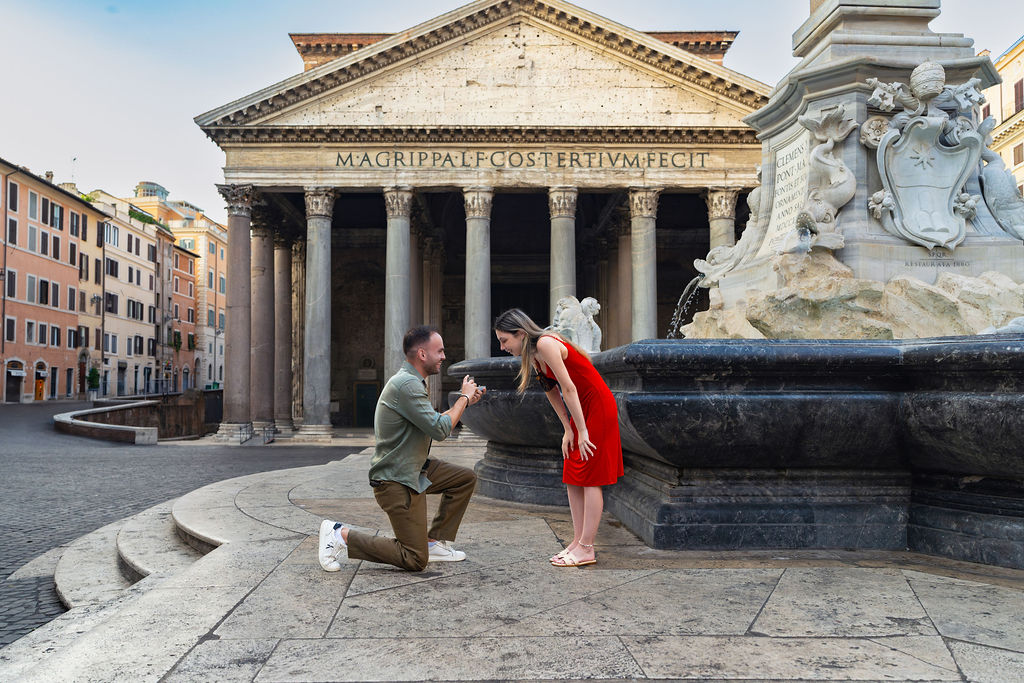
The Chronological Cut-off: The 09:00 Rule
The primary constraint of the Piazza della Rotonda is the density of human traffic. In the city of Rome, the transition from a navigable public space to a congested tourist zone occurs rapidly.
- Hard Cut-off: All primary photography must be concluded by 09:00 AM. Beyond this threshold, the presence of tour groups, commercial deliveries, and the opening of surrounding cafes creates significant "visual clutter" that degrades the background integrity.
- The Recommended Slot (07:30 – 08:30): The professional recommendation for a proposal at the Pantheon is to commence at 07:30 AM and finalize the session by 08:30 AM. This window provides a 30-minute buffer before the 09:00 AM surge.
- The Logic of the Window: Starting at 07:30 allows for the capture of ambient light as it first begins to illuminate the Pantheon’s pediment. By finishing at 08:30, the subject remains the primary focus of the frame without the interference of the "urban noise" that characterizes mid-morning Rome.
Book Your 2026 Surprise Proposal Session
Ensure your Roman proposal is captured with the highest technical precision. We are now accepting reservations for the Spring and Summer 2026 seasons. Secure your date via our formal booking portal.
Secret Proposal Photoshoot with Local Photographer
Seasonal Solar Calibration
While the 07:30–08:30 window is the standard, the exact timing must be calibrated according to the season. The solar elevation angle significantly impacts how shadows fall across the Pantheon’s portico and the Piazza’s stone pavement.
- Summer Sessions (May – September): In the summer months, the sun rises earlier and reaches a higher intensity by 08:00 AM. To avoid harsh, vertical shadows under the subjects' eyes, an earlier start (closer to 07:15) is advised.
- Winter Sessions (November – February): During the winter, the "blue hour" transitions more slowly into daylight. A start time of 07:45 or 08:00 may be necessary to ensure there is enough light for the high-shutter speeds required to capture the candid moment of the proposal.

Spatial Strategy: The "Left of Fountain" Advantage
In the Piazza della Rotonda, the Fontana del Pantheon serves as a central landmark. However, from a technical perspective, the positioning of the subjects relative to this fountain is the most critical variable for image composition.
- Optimal Position: The best location for the proposal is to the left of the fountain (when viewed from the perspective of an observer facing the Pantheon).
- Operational Benefits:
- Open Field of View: The left side of the fountain provides a wider, unobstructed space. This allows the photographer to maintain a discreet distance while utilizing long focal lengths, which is essential for preserving the "surprise" element of the session.
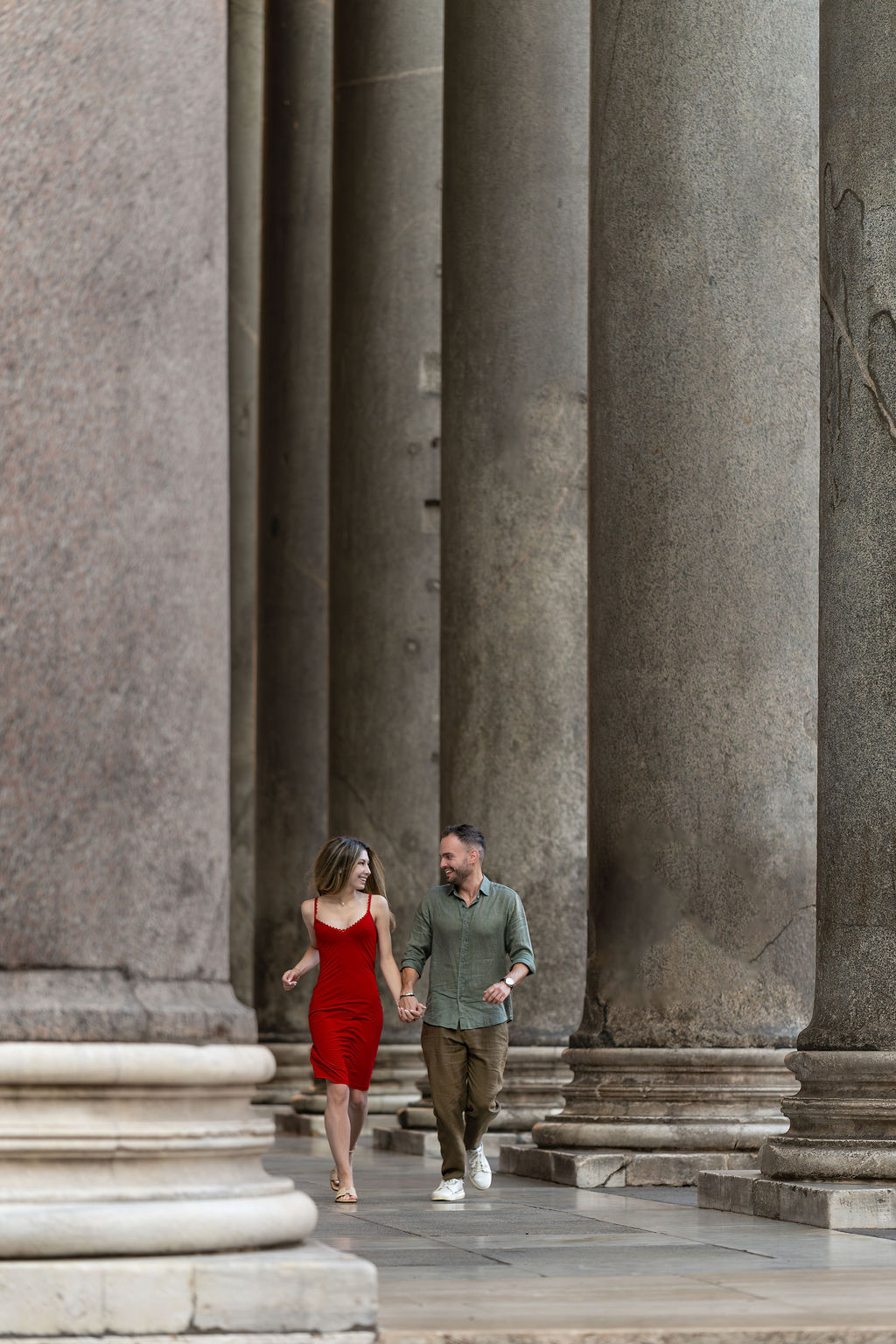
- Architectural Framing: From this specific angle, the photographer can align the subjects perfectly with the massive granite columns of the Pantheon’s portico. This creates a powerful foreground-to-background relationship, ensuring the architectural scale of Rome is represented without obscuring the subjects.
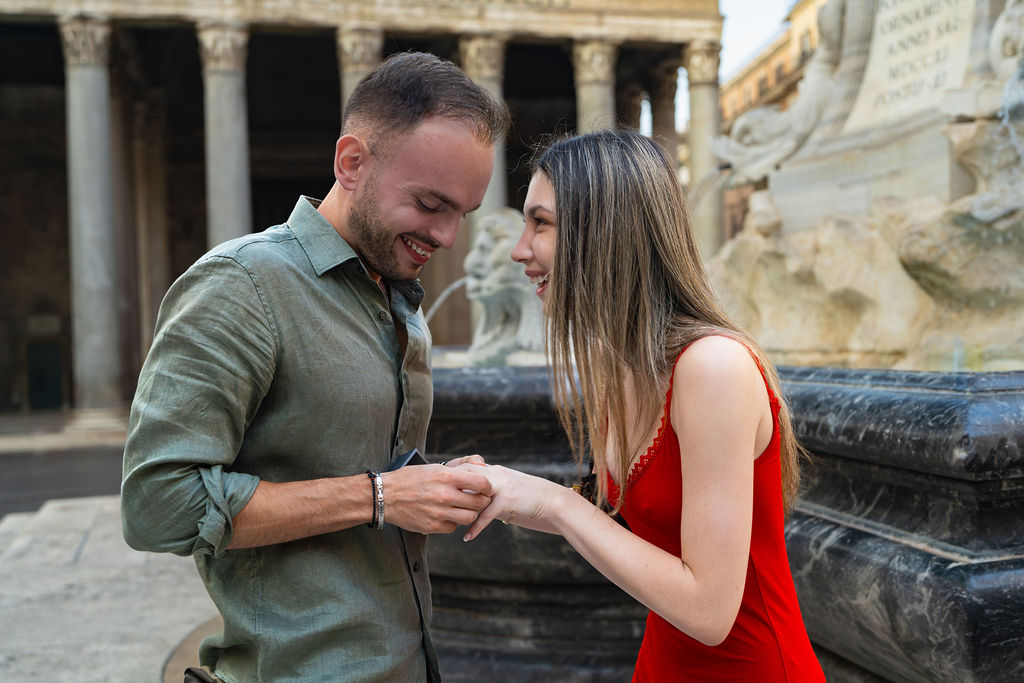
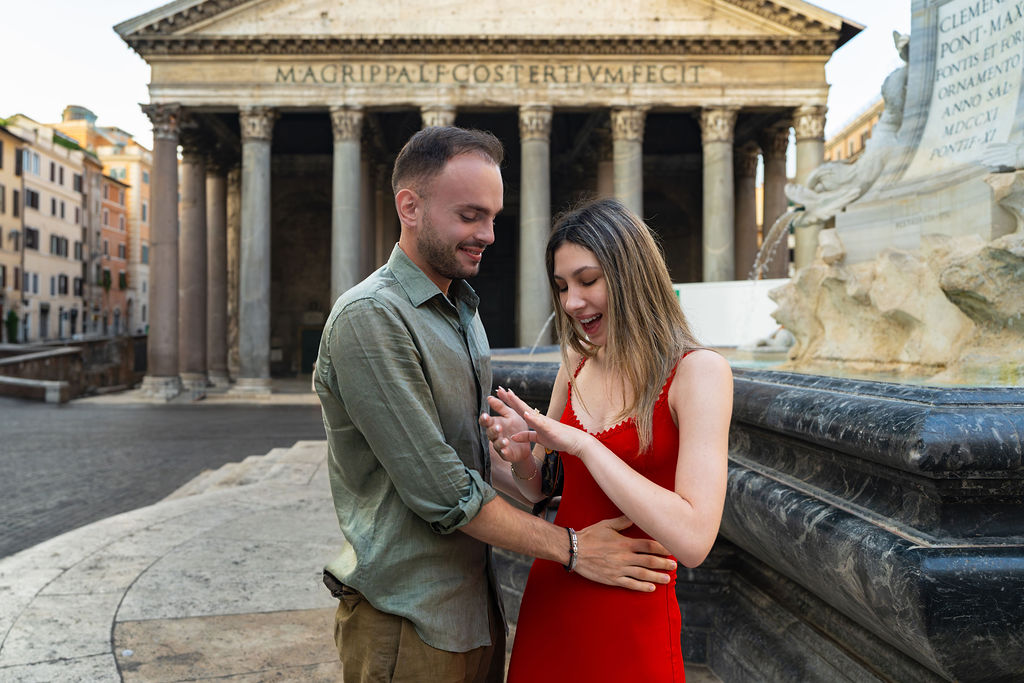
- Subject Visibility: As demonstrated in technical case studies, the left-hand position allows the man to kneel in a way that provides the camera a clear view of both faces and the engagement ring, without the fountain’s stonework blocking the line of sight.
Technical Rendering: 16-Bit Dynamics in High-Contrast Stone
A proposal at the Pantheon often involves extreme lighting contrasts—the bright, reflective stone of the piazza versus the deep, dark shadows inside the Pantheon’s portico. Standard 8-bit or 12-bit digital systems often fail to resolve these extremes, resulting in "clipped" highlights or "noisy" shadows.
At Eidos Photography, we mitigate this by utilizing 16-bit medium format capture. The $2^{16}$ levels of color depth (65,536 levels per channel) allow for:
- Highlight Recovery: Preserving the intricate details of the Pantheon’s Corinthian capitals even in direct morning sun.
- Tonal Continuity: Ensuring that the textures of the subjects' clothing—such as a vibrant red dress against the muted greys of the Roman stone—are rendered with absolute chromatic fidelity.

Coordination and Discretion Protocols
A surprise proposal requires a high degree of "operational silence." The photographer must be integrated into the environment as a non-participant.
- The Pre-Arrival Brief: The client and photographer must finalize the "Left of Fountain" target via a digital map 24 hours prior to the event.
- The Signal: A non-verbal signal (such as the client stopping to check their watch or a specific phone notification) is used to indicate that the "Proposal Event" is imminent.
- Equipment Choice: Telephoto prime lenses are utilized to ensure that the photographer does not have to approach the subjects, maintaining the candid nature of the moment.
Managing Background Integrity (Visual Clutter)
The reason we insist on the 08:30 AM completion is the management of Background Integrity. After 08:45, the surrounding restaurants begin to deploy umbrellas, menus, and chairs. This adds unnecessary geometric shapes to the background that distract from the symmetry of the Pantheon. By sticking to the early-morning protocol, the frame remains "clean," consisting only of the subjects, the ancient architecture, and the historical cobblestones.
Book Your Tourist Photography in Rome
Elevate your travel experience with our high-end editorial standards. For clients seeking professional Tourist Photography in Rome featuring 16-bit medium format output and strategic location management, visit our booking page to secure your 2026 session.
Reserve Your Session at Eidos Photography
Conclusion
A successful surprise proposal at the Pantheon is a result of meticulous planning rather than chance. By adhering to the 07:30–08:30 window and utilizing the tactical position to the left of the fountain, clients ensure that their session is free from the logistical interference of Rome’s daily tourist cycle. Technical excellence in such a high-contrast environment is only achievable through early-morning timing and the use of high-dynamic-range equipment.
Asieh Orouji


%401x.svg)
%402x%20(5).svg)
