
%402x%20(5).svg)
Cart
(
)
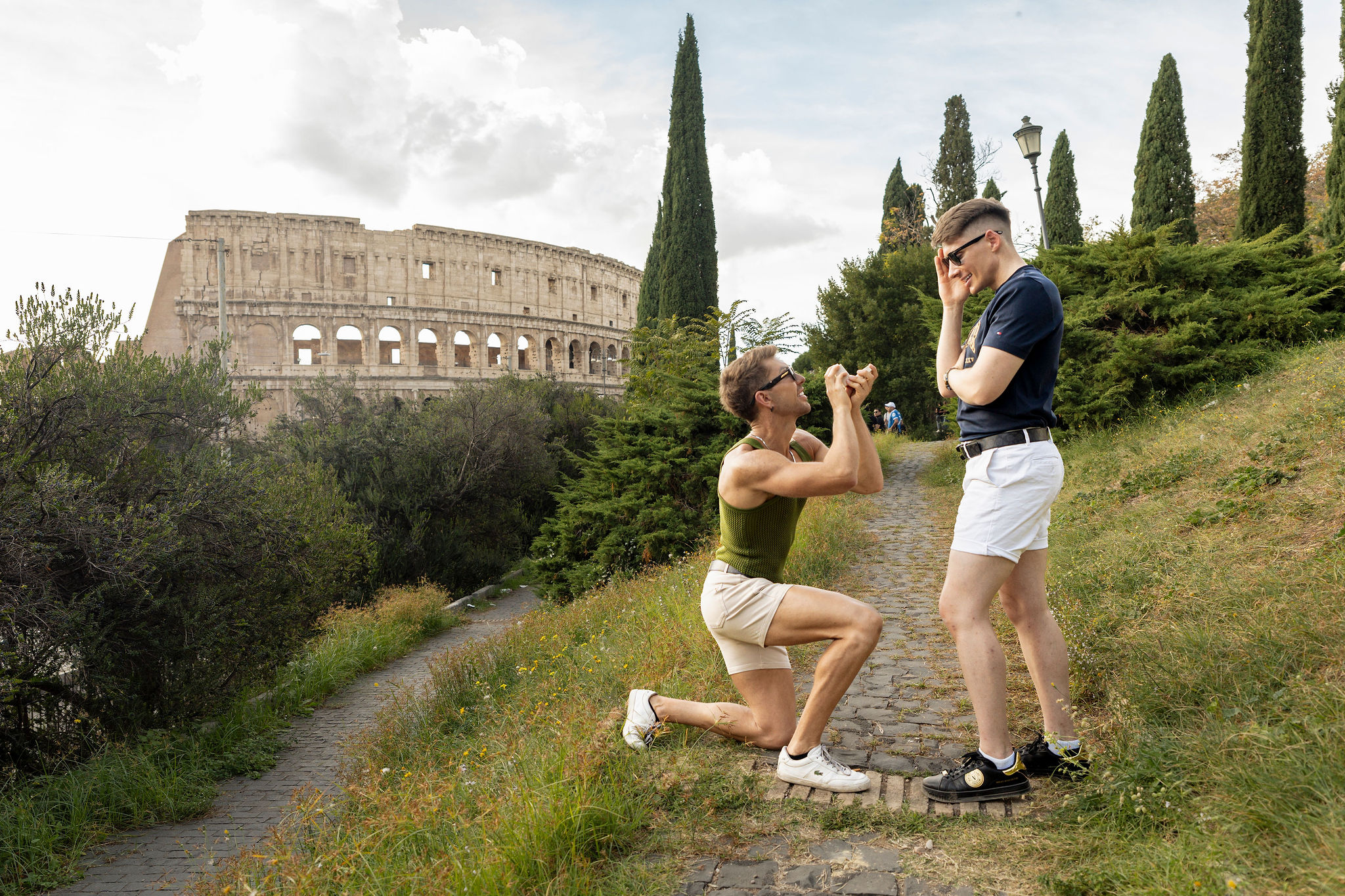
He dropped to one knee as the Colosseum glowed in the late afternoon light. No one else was around — just a specific corner of a quiet street that overlooks the iconic arch, a photographer hidden nearby, and a promise that had been years in the making. The answer was yes before the ring came out of the pocket. And for the first time that day, neither of them had to think about who was watching or what anyone might think.
That’s the proposal I want you to imagine for yourself. Not a postcard moment — those exist everywhere in Rome — but a moment that belongs entirely to you.
I’ve photographed dozens of same-sex proposals across Rome, and I’ve learned something each time: the biggest difference between a couple having a beautiful proposal and a couple having a proposal that feels right isn’t the location or the outfit. It’s feeling safe enough, and private enough, to actually be yourselves when the moment happens.
This guide is for couples planning a proposal in Rome. It’s honest about what you’ll encounter, practical about how to handle it, and it includes the questions I get asked most often.
Let me start here because this is always the first question: Yes, Rome is generally welcoming to same-sex couples. But “welcoming” doesn’t mean uniform, and it’s not guaranteed.
Italy legalized same-sex civil unions in 2016 and has been moving toward greater legal protections for LGBTQ+ people. Rome, as Italy’s capital and a global city, is significantly more progressive than smaller towns. You’ll see same-sex couples openly together in the city center — holding hands, kissing in restaurants, walking arm-in-arm through piazzas.
And yet.
Some travelers have reported unwanted stares, unsolicited comments, or discomfort with public displays of affection. These experiences are real, even if they’re not universal. My job is to help you navigate that reality without letting fear dictate the day.
Here’s what I’ve observed in thirteen years of photographing LGBTQ+ proposals in Rome:
• Tourist-heavy areas (Trevi Fountain, Spanish Steps, the Colosseum perimeter) are the most cosmopolitan. Thousands of people from everywhere pass through daily. Stares are rare; indifference is the default.
• Early morning and late afternoon are quieter, which can feel safer. A 7 AM session at Trevi has maybe fifty people around instead of five hundred. That means more space, fewer eyes.
• Quieter corners — side streets, parks, overlooks — let you have a moment to yourself. This is what I recommend, and it’s what worked for that proposal I started with.
• Assumption and invisibility work in your favor. People in Rome see what they expect to see. Two people of any gender holding each other at sunset? Most people don’t examine it too closely.
The reality: I have never photographed a same-sex proposal in Rome where the couple felt unsafe during the proposal itself. But I have worked with couples who were anxious beforehand. That anxiety is valid, and it’s worth addressing directly.
When you book with me for an LGBTQ+ proposal session, here’s what’s different:
1. We choose your location together — not just for aesthetics, but for how private it feels. Some couples want semi-public (Trevi Fountain, early morning). Others want genuinely secluded (a side street overlooking the Colosseum, a corner of Villa Borghese). Both are beautiful. Both are completely valid.
2. I’m positioned far enough away that you can’t see the camera. You won’t be self-conscious. You’ll be in your own moment.
3. I have a plan for the energy and pacing. If you want to take a breath before the moment, we do. If you want time to laugh or cry or just hold each other before I start shooting, we take it. The proposal is not a performance; it’s a celebration.
4. Everything about the photos is your choice. You decide what gets shared, where, and when. If you’re not out to everyone yet, that’s completely respected. If you want photos published, tagged, and shouted from the rooftops, I make that happen. That’s your story to tell.
I photograph proposals at these locations most often. Here’s what makes each one work for an LGBTQ+ couple:
Why couples choose it: It’s the most recognizable landmark in Rome, and it’s symbolic — ancient, powerful, lasting.
The LGBTQ+-specific advantage: You don’t have to propose at the Colosseum, surrounded by tourists. Instead, there’s a street on the eastern side (near the Fori Imperiali) where you get an iconic view with almost no crowds. Early morning or late afternoon, it’s peaceful.
Best time: 6:30–7:30 AM or 5–6:30 PM (depending on season)
Photography notes: The light is golden, the angle is dramatic, and the couple is the focus — not the landmark.
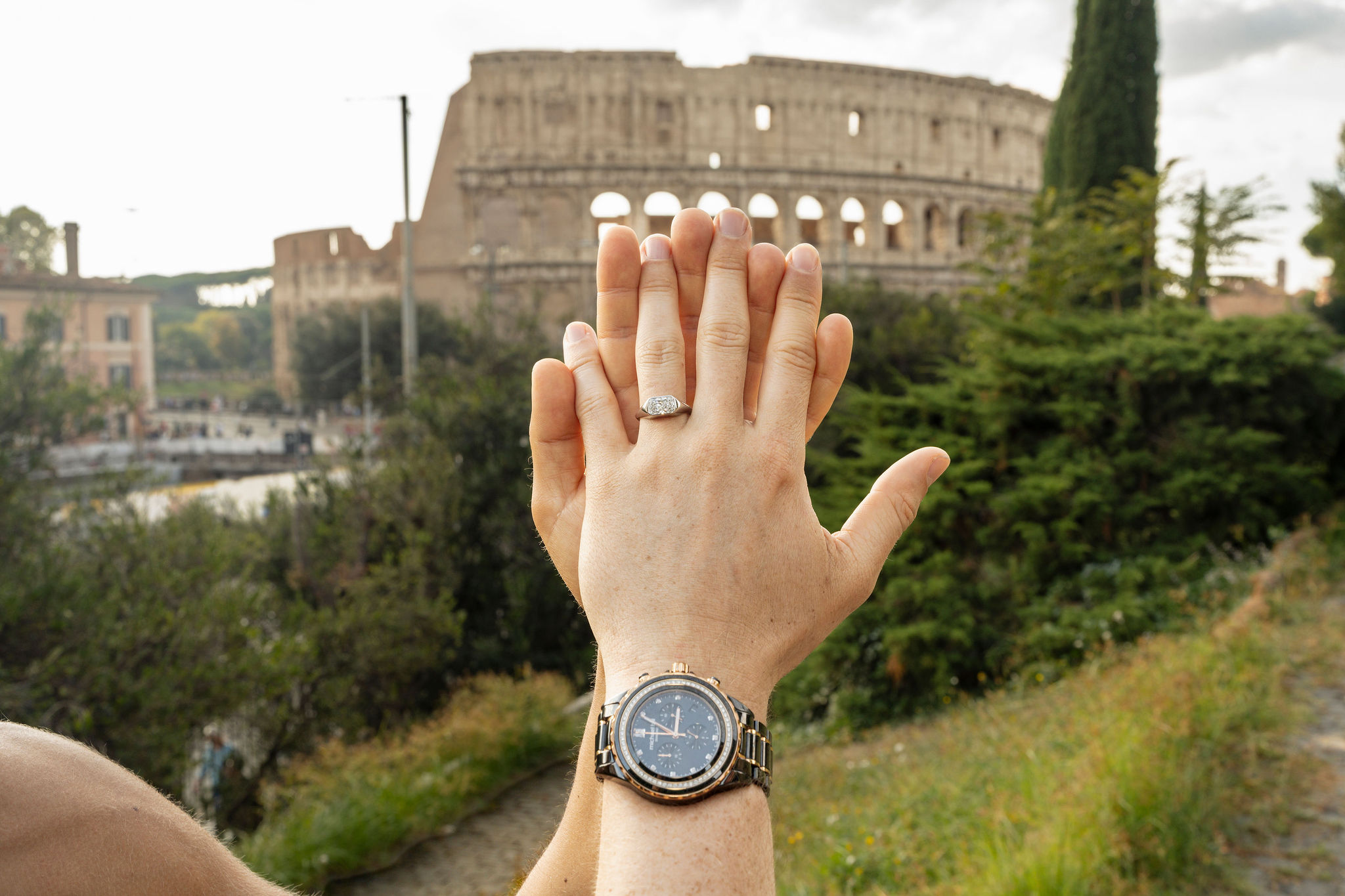
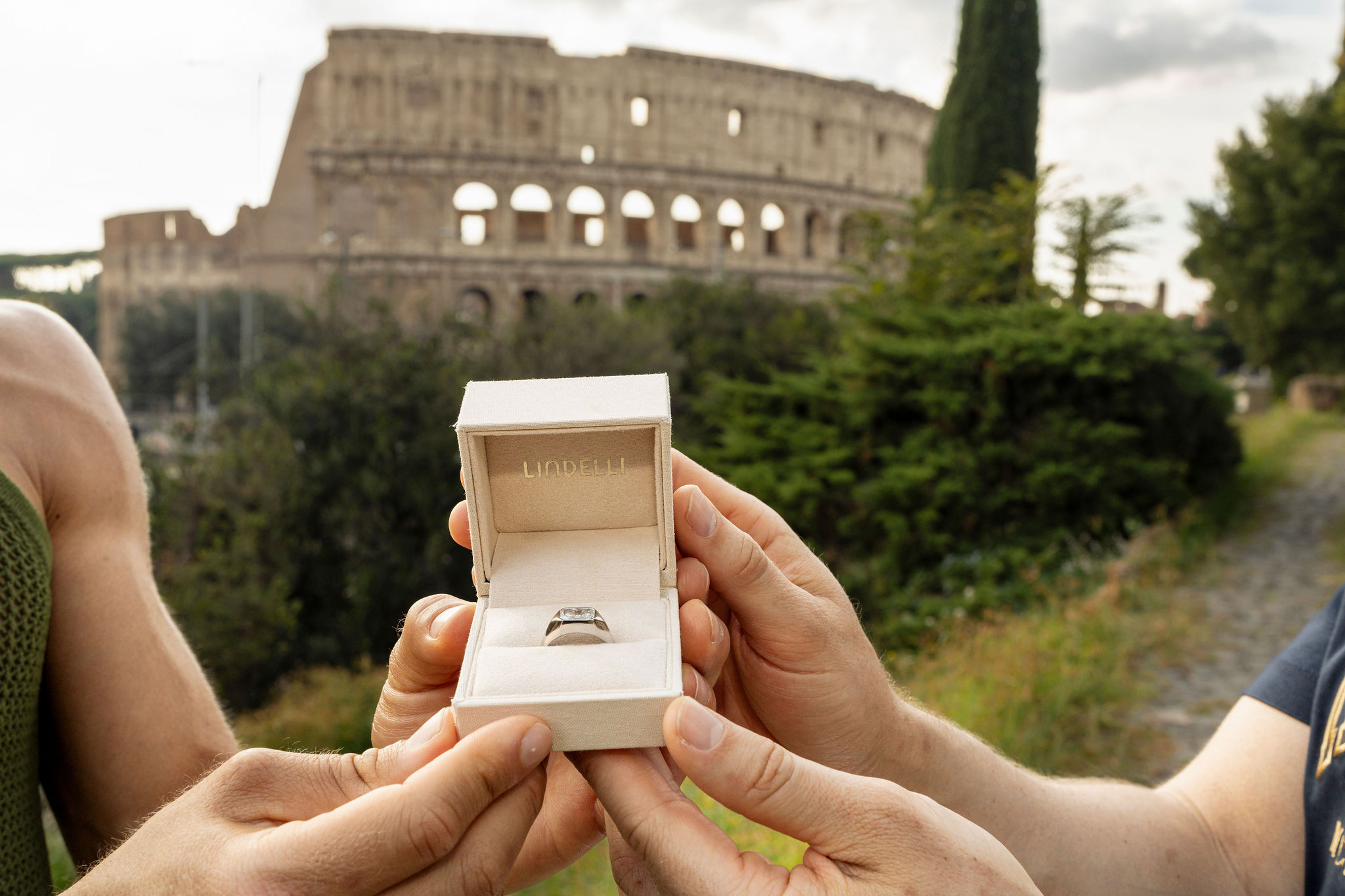
Real experience: One couple I photographed chose this spot. She got down on one knee facing him, with the Colosseum glowing behind them. No one else was around. Afterward, they walked around the area for portraits, and even in broad daylight, the vibe was calm.
Why couples choose it: Genuinely beautiful, genuinely feels like a park instead of a tourist attraction. Space to breathe.
The LGBTQ+-specific advantage: Lots of space, lots of diversity. Families, couples of all kinds, solo travelers, locals. It’s normal to see people of every configuration together. The energy is relaxed and accepting.
Best time: Morning (8–10 AM) for fewer crowds and softer light; late afternoon (5–7 PM) for golden hour without the heat.
Photography notes: So many options — fountains, sculptures, tree-lined paths, open fields. We can do a proposal in a quiet corner and then move for portraits without moving far.
Real experience: A couple did their proposal at the fountain in Villa Borghese. The moment was private (off to the side, early morning). Afterward, they walked through the gardens laughing, holding each other, and we captured the full range of emotions. The photos felt intimate and joyful.
Why couples choose it: It’s Trevi Fountain. It’s iconic. It’s on the list.
The LGBTQ+-specific advantage: At 7 AM, there are maybe a hundred people, not a thousand. The morning light is soft. And you can propose at Trevi without it feeling like theater.
Best time: 7–8 AM, no exceptions. After 9 AM, crowds make intimacy almost impossible.
Photography notes: I position myself to include the fountain but focus on the couple. The city wakes up around you. It’s actually beautiful.
Real consideration: The crowds at Trevi are international and used to proposals — people cheer, strangers smile. Some couples love that energy. Others find it overwhelming. Know which one you are.
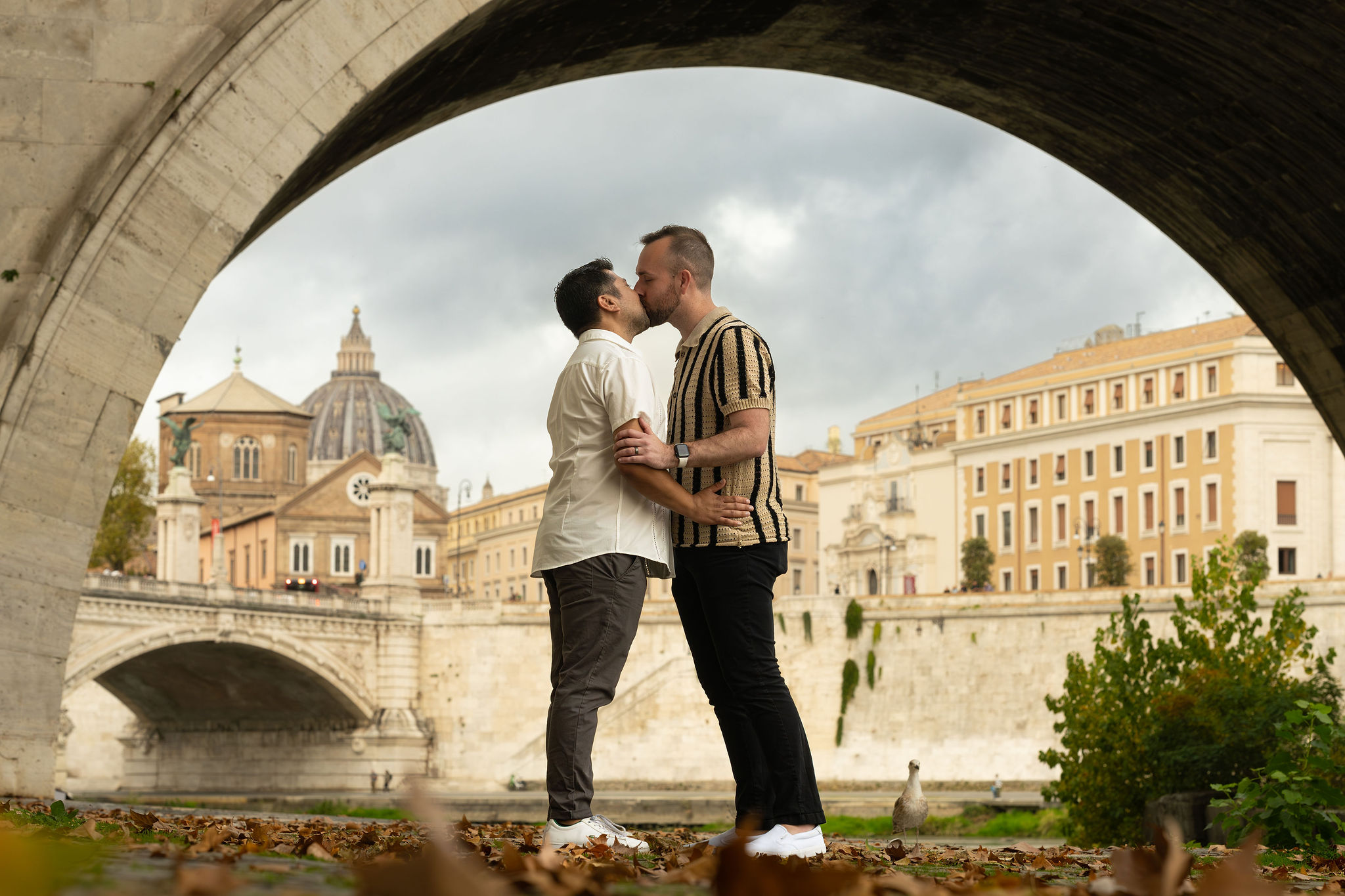
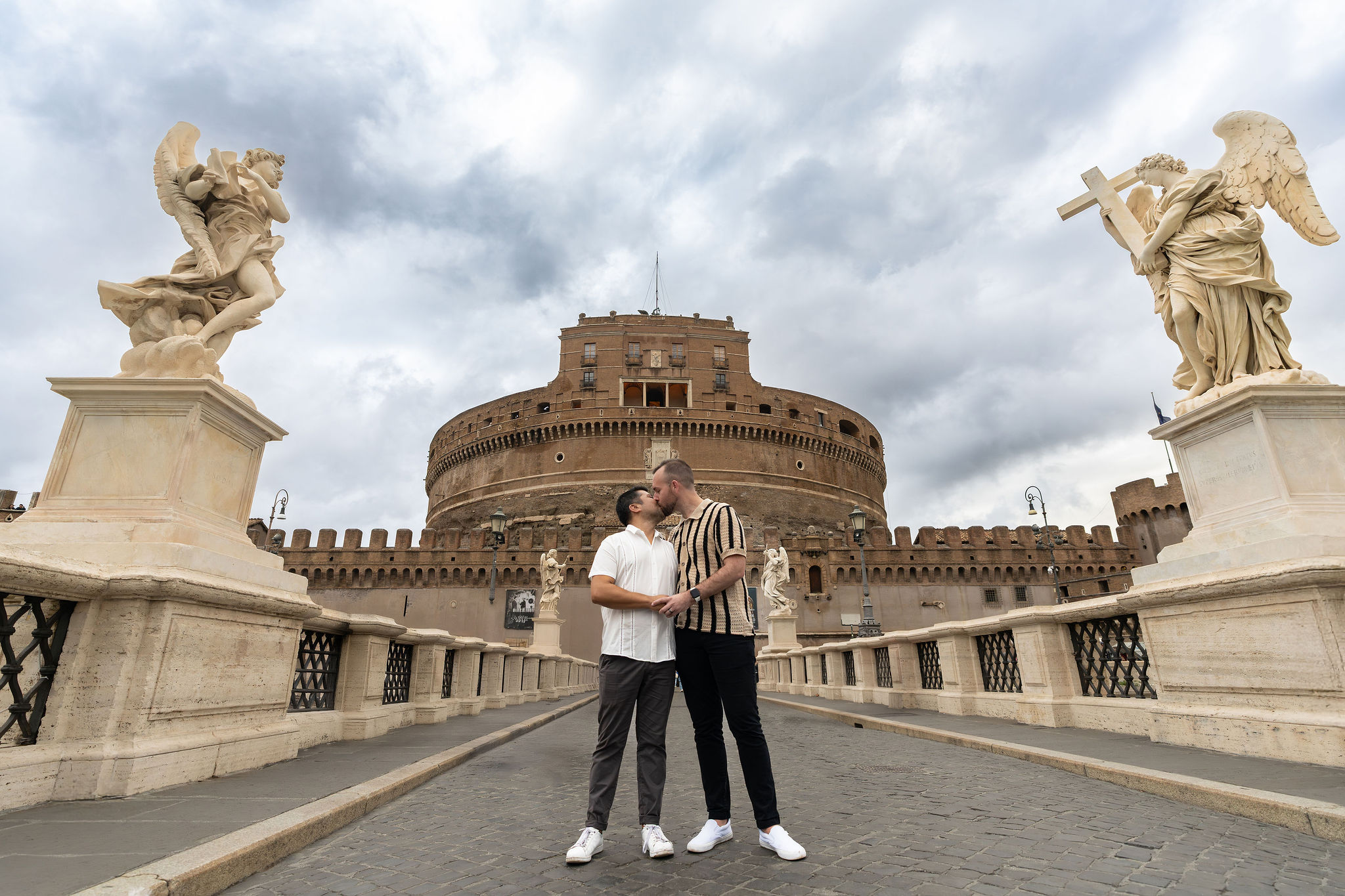
Why couples choose it: Fewer tourists than the big landmarks, still incredibly photogenic. A bridge with a view over the Tiber, a castle, history.
The LGBTQ+-specific advantage: It’s quiet, it’s lovely, and the vibe is couples-oriented. Many LGBTQ+ travelers mention it as a favorite Rome spot.
Best time: Late afternoon (5–7 PM)
Photography notes: The light on the Tiber at sunset is golden. The bridge itself is romantic without being overdone. We can do the proposal on the bridge and then walk for portraits.
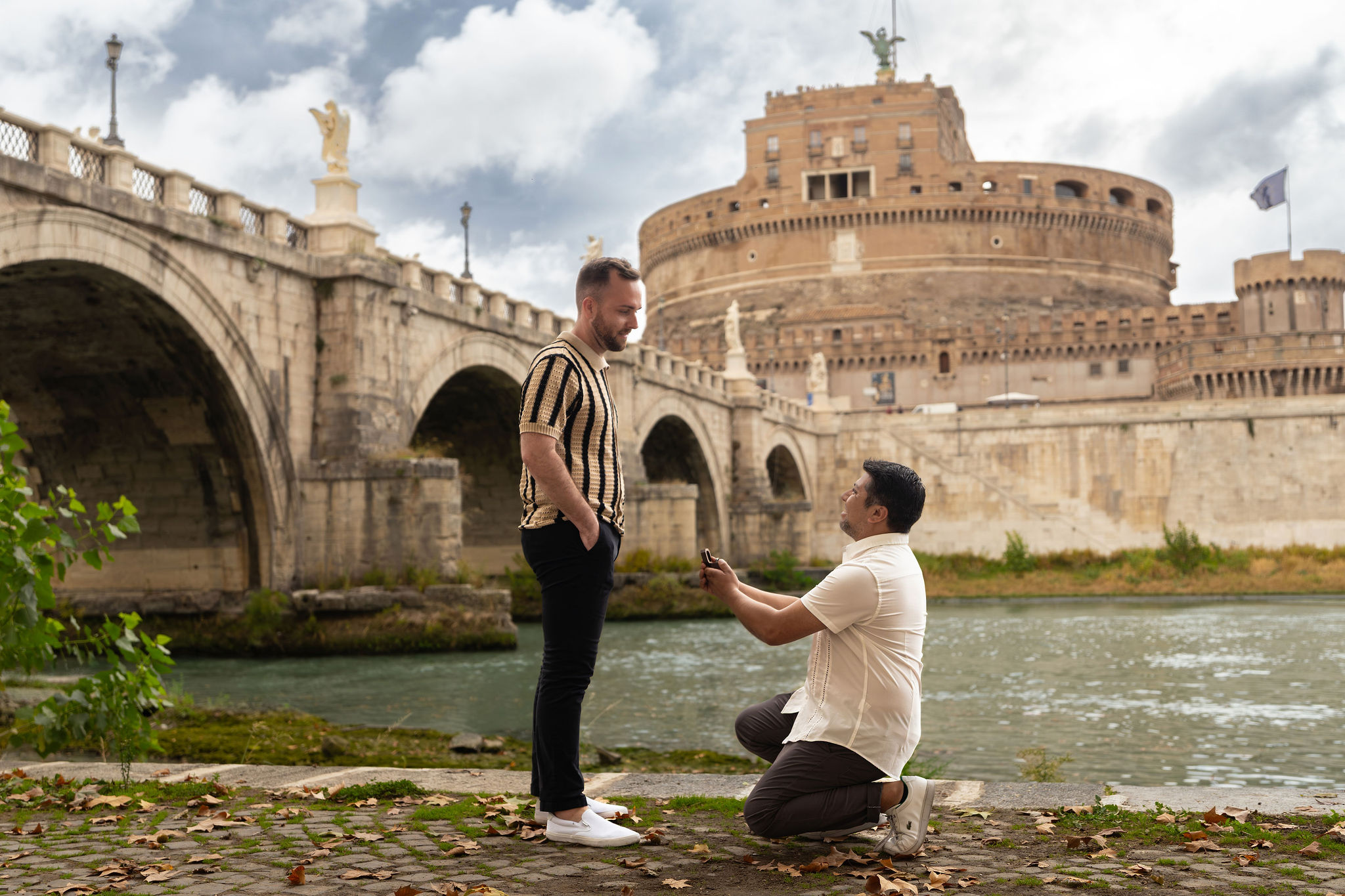
Real experience: That proposal I mentioned at the start — that was near the Colosseum, but we’ve also done stunning proposals at Castel Sant’Angelo. The castle backdrop is softer than the Colosseum, less iconic, but deeply romantic.
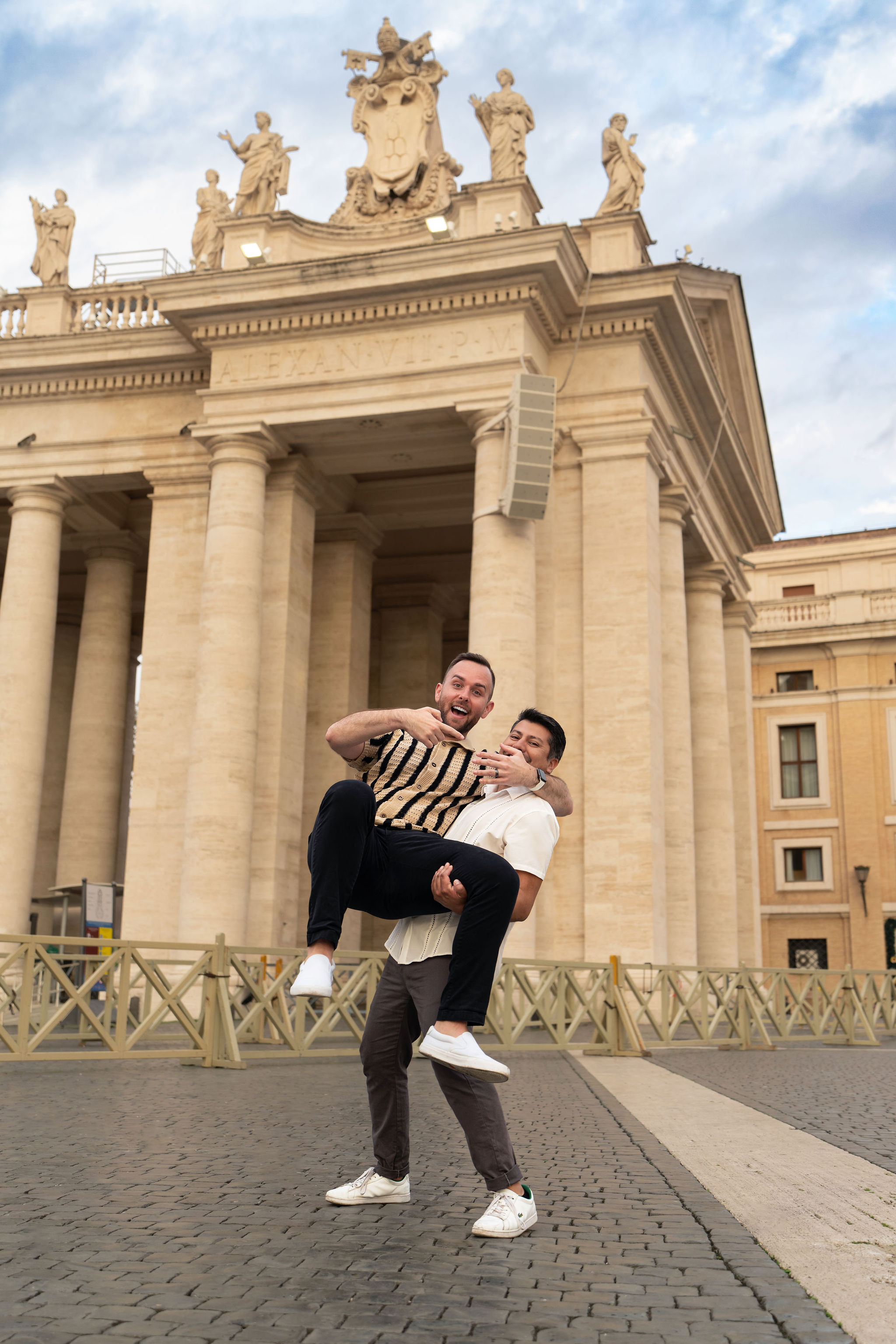
This is the question I get in more words than any other: Is it safe to kiss / hold hands / be physically affectionate in public in Rome?
The short answer: Yes, with context.
The longer answer:
• In busy, touristy areas: Same-sex couples are common. No one bats an eye. I see it constantly.
• In quiet neighborhoods or smaller towns around Rome: Conservative attitudes exist. A kiss at a proposal might get looks. It’s rare but possible.
• On a side street at the Colosseum at 6:30 AM: You have the space and privacy to do whatever feels right, and witnesses will be few.
This is why location matters so much for an LGBTQ+ proposal in Rome. It’s not that the city is unsafe. It’s that some spots afford you privacy, and privacy lets you relax.
My recommendation: Choose a location where you feel genuinely alone for the moment itself. Alone doesn’t mean abandoned — it means far enough from dense crowds that you can breathe. Then, after you’ve kissed and celebrated and taken a moment to yourselves, you can be visible for portraits if you want. The proposal itself deserves privacy. What comes after can be as public as you want.
Here’s something I realized after photographing dozens of same-sex proposals: many couples have never seen an example of what they want to do. There’s no script for this. You get to write it.
Some same-sex couples plan one person to propose, and the other says yes. Some plan for both people to propose to each other. Some do a single proposal and then a later vow renewal. Some do matching simultaneous proposals.
All of these are beautiful. None is more “right” than the others.
One proposal: - Simpler, clearer moment. The person proposing leads; the other experiences the surprise. - Often feels traditional, which some couples want and others don’t. - Still deeply intimate.
Two proposals (sequential): - Both people get to plan something and experience the joy of proposing. - Takes more coordination and trust not to spoil the surprise. - Means two distinct photo moments, two different stories.
Mutual / simultaneous proposal: - Symbolic. Neither person is more the proposer; it’s a shared decision made at the same moment. - Takes serious coordination beforehand. - Photographs beautifully — both people reaching for each other at once is striking.
What I’ve seen work best: Whatever you choose, choose it together beforehand. Don’t surprise each other about the proposal structure — only surprise about timing or location. That way, you’re both excited for the same reason.
Similarly, some couples buy one ring (and the other person wears it or will buy their own later). Some buy matching rings. Some buy complementary rings. Some don’t wear rings at all.
Your choice. Completely.
What I photograph is what you present to me. If it’s one ring, great. If it’s two, better. If it’s a piece of paper, a key, or just a moment of kneeling down — I’ll photograph it with the same care and attention.
You’re going to search for photographers in Rome, and many will say they’re LGBTQ-friendly. Here’s what I wish every couple knew to look for:
• Photos of only opposite-sex couples in their portfolio
• Language like “traditional wedding” or “bride and groom” with no mention of flexibility
• No LGBTQ+ proposals, weddings, or ceremonies in their past work
• A website that doesn’t address LGBTQ+ couples directly
• A visible portfolio of same-sex couples — proposals, weddings, engagements. Not just one token couple; several. This shows experience and intention.
• Direct language acknowledging LGBTQ+ couples. “Same-sex couples, non-binary couples, and LGBTQ+ partnerships — I photograph all of them” is what you want to hear.
• Discussion of consent and comfort. A photographer who asks questions like “Do you want to be affectionate in front of the camera?” and “How do you want to present yourselves?” is one who respects your autonomy.
• No heteronormative posing language. Avoid photographers who talk about posing in terms of “the man does this, the woman does that” or assume certain roles. Look for: “I guide couples into natural positions,” “You set the tone for how we pose,” or “Tell me how you naturally stand together.”
Before booking anyone for your LGBTQ+ proposal:
1. Do you have experience photographing same-sex proposals specifically? (If yes, ask to see the portfolio.)
2. How do you approach posing for couples who don’t fit traditional masculine/feminine roles? (Listen for flexibility and respect for your preferences.)
3. What’s your policy on sharing and publishing photos? (Make sure they ask for permission before posting anything, especially if you’re not out to everyone.)
4. How do you handle the moments if emotions get big — tears, overwhelm, or just needing quiet? (Good photographers have a strategy for this.)
5. Have you worked in this location before for same-sex couples? What was it like? (Specific experience matters.)
Early morning (6:30–8 AM): - Fewest crowds - Soft, golden light - Cooler temperature (helpful if summer) - Requires an early wake-up (but it’s worth it) - Best for: Couples who want maximum privacy and don’t mind being up at 6 AM
Mid-morning (10 AM–12 PM): - Still relatively quiet - Light is bright but not harsh if you’re in shade - Can be warm in summer - Good for: Couples who like morning but not super early
Late afternoon (4–6 PM): - Golden hour (best light of the day) - Tourist sites are still busy, but you can find quiet corners - Warmer in summer, but more tolerable than midday - Good for: Couples who want beautiful light and don’t mind some crowds nearby
Early evening (6–7 PM): - Golden, soft light - Fewer tourists (many have left for dinner) - Can be cold in winter - Good for: Couples who like evening energy and privacy
My recommendation: Early morning or late afternoon, depending on your comfort with waking up and your love of golden hour light. Both are stunning for photography.
Here’s how I structure a typical LGBTQ+ proposal session:
Part 1: Arrival & Connection (15 minutes) We meet, you see me and the camera, and then I disappear. I position myself far away. You take a breath. Maybe you walk around the location together first, settle your nerves, remember why you’re doing this.
Part 2: The Proposal (5–10 minutes) This is the moment. One person proposes, or you both do, or whatever you planned. I’m shooting the whole time, but you won’t see me. You’re living the moment, not performing it.
Part 3: The Celebration (10–15 minutes) You’ve said yes. You kiss, you cry, you laugh, you hold each other. I’m still capturing this. It’s raw and real.
Part 4: Portraits (30–60 minutes, depending on your package) Now we do the posed, intentional photos. You’ve had your private moment. Now we celebrate it with images that show you as a couple, as individuals, in love, in this city.
Total time: Usually 90 minutes to 2 hours, depending on what you book.
Wear something that feels like you. Seriously.
Some LGBTQ+ couples buy matching outfits. Some wear their everyday clothes. Some dress up formally. Some wear cultural or meaningful clothing. What matters is that you feel like yourselves and that the clothes let you move and breathe.
Practically speaking: - Comfortable shoes (you might walk a lot for portraits) - Layers (Rome’s weather can swing; churches are cold, streets are hot) - Colors that photograph well and make you feel beautiful (this is different for everyone) - Pockets, if possible (photographer needs to stash your ring)
This is non-negotiable: Your photos are yours. What gets published, where, and when is entirely your choice.
When you book a proposal with me, here’s how we handle it:
1. I deliver all photos — no gatekeeping. You get the full gallery.
2. I ask your permission before posting anything on social media or my website. Not assumed. Asked.
3. If you’re not out to everyone yet, your photos are kept completely private. I won’t tag you, post about you, or share them anywhere.
4. If you want to be featured, we talk about what that looks like. Some couples love being on the blog; others just want the private gallery.
5. You can ask for specific photos not to be shared, and I honor that completely.
The reason this matters: some couples are at different stages of being out. Some live in places where visibility is complicated. Some just want privacy about this moment. All of that is okay, and all of that is respected.
1. Is it actually legal to get married in Rome as a same-sex couple?
Not immediately. Italy recognizes same-sex civil unions (legally) but not full marriages (as of 2026). However, if you’re citizens of countries where same-sex marriage is legal (US, UK, Netherlands, Spain, Portugal, many others), your marriage is recognized in Italy. A proposal is just a proposal — no legal paperwork needed. If you want to eventually marry, you can do it in your home country and celebrate/renew vows in Rome.
2. What if someone makes a rude comment or stares during the proposal?
Honestly? It hasn’t happened to any couple I’ve photographed. But if it did, here’s the plan: I’d subtly move you to a different spot (I’m always scouting alternatives), or I’d stay close enough to respectfully intercede if needed. In most cases, a moment of rudeness from a stranger is a blip. Your moment is bigger than that person’s opinion. But you won’t be alone if anything uncomfortable happens — I’m there, I’m paying attention, and I know Rome.
3. Q: Do we need to book any special permits or permissions to propose at famous landmarks?
No permits needed for a proposal (unless you’re doing something elaborate like hiring musicians or blocking off areas, which most couples don’t). You can propose anywhere in Rome that’s public. However, if you want to be inside a church for a blessing, that’s arranged in advance with the clergy (and usually happens on a booked date, not spontaneously).
4. I’m worried about being out in public. Can we do this more privately — like in a hotel room or a private venue?
Absolutely. Some couples do private proposals indoors. It’s less about Rome’s energy and more about just having the moment be yours. The tradeoff is that Rome’s backdrops are stunning — but your comfort comes first. We can do proposals indoors, in private villas, or in very secluded locations if that’s what feels right.
5. What if we’re from different countries and have questions about legal stuff (marriage rights, visas, etc.)?
Those are important questions, but they’re outside my expertise as a photographer. I recommend checking with organizations like ILGA-Europe (ilga-europe.org) or your country’s embassy for specific legal and immigration questions. I can photograph your proposal; I can’t advise on citizenship or legal recognition.
6. How much does a proposal photo session cost?
I offer several packages ranging from 1.5 hours to full-day sessions. Details are here, and I’m happy to customize based on your needs.
7. Can we do a proposal in Rome if we’re not technically engaged yet — like, he’s going to propose, but she hasn’t decided yet?
This is a genuinely thoughtful question, and the answer is yes — but here’s the thing: once that yes happens, you’re engaged. You’re engaged immediately. The proposal formalizes the commitment, but the feelings and decision are happening in real time, in front of a camera, with me watching and photographing. That’s huge. If either of you has doubts, a proposal isn’t the moment to work through them. But if you’re both excited and this is just a beautiful way to make it official? Then absolutely, let’s go.
8. Should the person proposing buy a ring without the other person’s input?
There are strong opinions on both sides. Personally, I think surprise about timing and location is wonderful. Surprise about a ring that might not fit, might not be the style the other person wants to wear every day, or might feel wrong somehow? That’s less ideal. Many modern couples choose rings together even if the proposal moment is a surprise. Whatever you choose, choose it based on what feels right for you two — not what tradition says.
9. What if we cry a lot during the proposal? Will it ruin the photos?
No. Crying looks beautiful in photos when it’s real. Tears, laughter, overwhelm — these are the moments that matter. I lean into emotion, not away from it. Your joy (and tears) are part of your story.
I’ve watched hundreds of proposals happen in Rome. The city is beautiful, sure. But what makes a proposal real — what makes it matter — is that it’s yours. It belongs to you and your person, on your terms, with your values and your story.
Rome didn’t invent love, and it doesn’t own commitment. But it does provide something rare: a place where thousands of people come to celebrate romance every single day, where history and modernity stand side by side, and where you can find a quiet corner to make a promise that will outlast the city itself.
You deserve that moment. You deserve a proposal that’s safe, that’s yours, and that’s celebrated exactly the way you want it to be.
Ready to plan your proposal? I’m here to help make it real.
Plan Your LGBTQ+ Proposal → Book a Custom Session
This article draws on my experience photographing LGBTQ+ proposals across Rome, conversations with hundreds of couples, and research into travel safety and community resources. Every couple’s experience is different, and this guide reflects what I’ve learned from those experiences.
If you have questions not covered here, or if you’d like to talk through your specific proposal idea, reach out. That’s what I’m here for.


%402x.svg)
%401x.svg)
%402x%20(5).svg)
