

One Morning, Three Moods: A Rome Wedding Portrait Experience
Most couples planning portraits in Rome start by picking a landmark. It's a reasonable place to start, but a single location, however beautiful, tends to produce a single kind of photo. What actually makes a gallery feel complete isn't one perfect backdrop. It's variety, in mood, in pace, and in how close the camera gets to the couple rather than the architecture around them.
This isn't a guide to the best photo spots in Rome, or the best time of day to shoot them. Plenty has already been written on both. What's less often explained is how three very different locations, used in a specific order, can turn a single morning into a gallery with an actual shape to it, rather than a collection of pretty but unconnected images.
This article walks through one recent early-morning session, photographed by Eidos Photography, built around exactly that idea: three locations, each doing a different job, photographed in a specific order so the final gallery reads as one story rather than three separate stops. The couple began at the Trevi Fountain, moved through the streets of Monti, and finished at the Colosseum. The early start was simply a practical condition, quieter streets and softer light, not the point of the session itself. The point was the shape of the gallery that resulted.
Why One Landmark Isn't Enough
A gallery built entirely around a single famous backdrop tends to repeat itself. The couple stands, the building fills the frame, and after the first few images, later ones start to feel like variations on the same shot rather than new moments. That's not a flaw in the location. It's simply what happens when the setting stays constant for an entire session.
This shows up clearly when a couple looks through a gallery afterward. The first two or three images from a location hold attention. By the tenth image in the same spot, with the same background and a similar pose, the eye starts skimming rather than pausing. Changing the setting resets that attention, and changing it to somewhere genuinely different, not just a different angle on the same building, resets it more effectively.
Combining locations with different scales and different atmospheres gives a gallery an actual arc, a beginning, a middle, and an end, rather than one long, flat sequence of similar-looking portraits.
The Three-Stop Arc
Iconic: The Trevi Fountain as the Opening
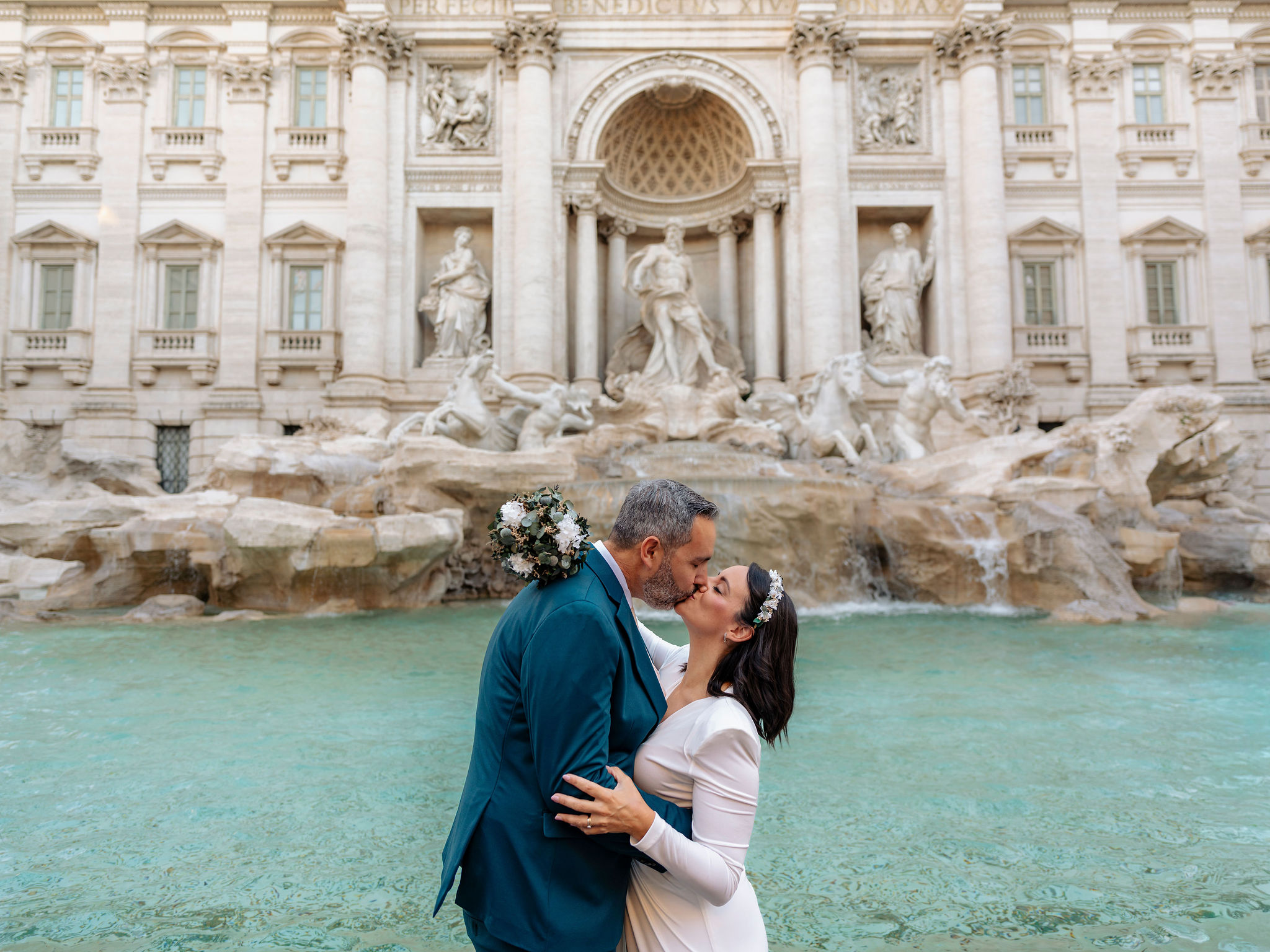
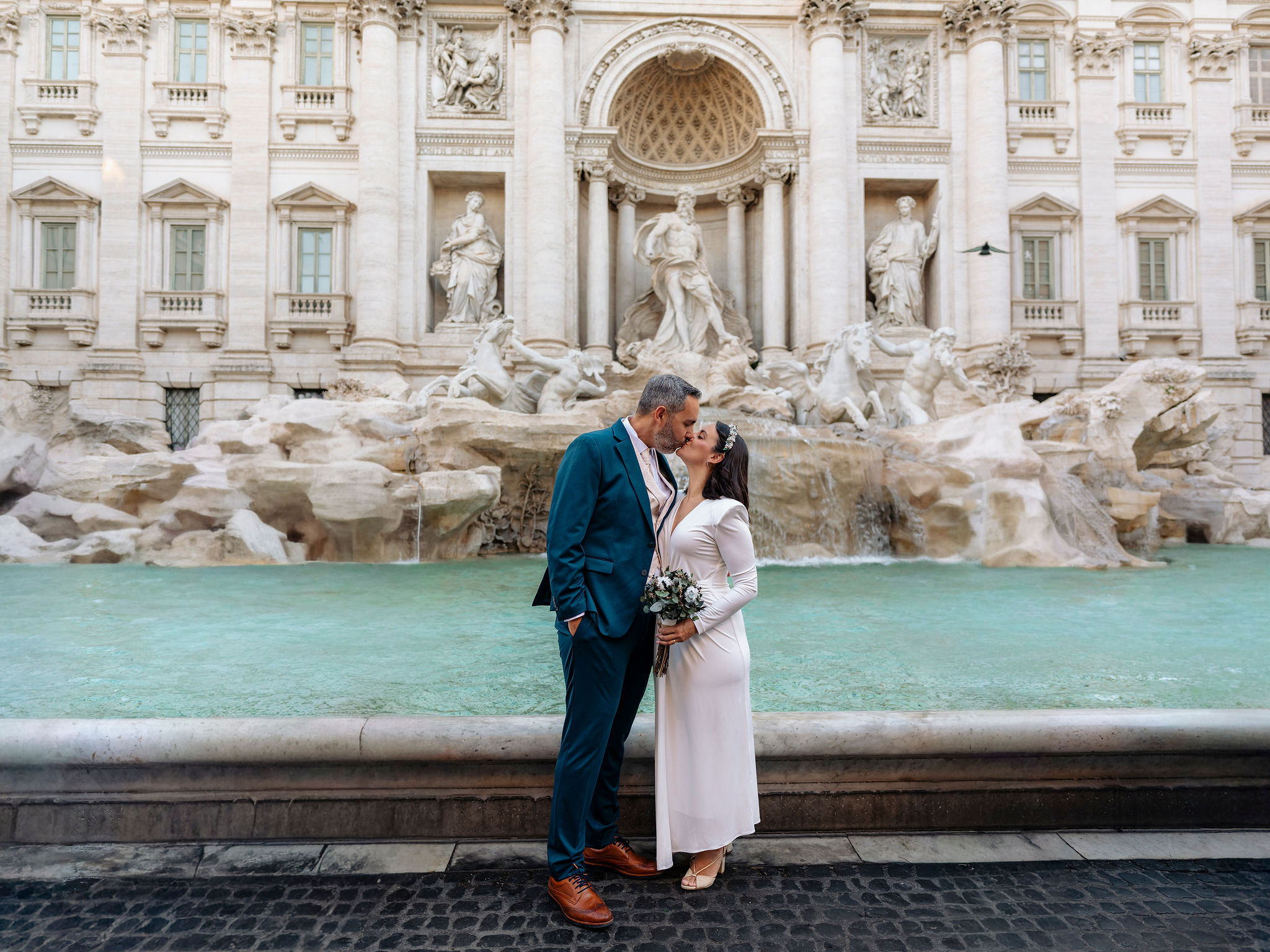
Starting at the Trevi Fountain sets a formal, unmistakably Roman tone for the gallery. Wide shots that include the full facade and the water place the couple clearly inside the city, which is exactly what an opening image needs to do. Closer portraits at the same location, framed against the marble and the fountain's carved figures, still carry that grandeur without needing the whole structure in frame.
This stage of the session tends to include the most classic, camera-aware images: the couple posed and looking toward the lens, a close embrace with the fountain behind them, a bouquet held between them, formal enough to work as a print or a main album image. It's an important part of the gallery, but on its own, it's only one register. A full session builds past it rather than staying there.
Intimate: Monti as the Turn
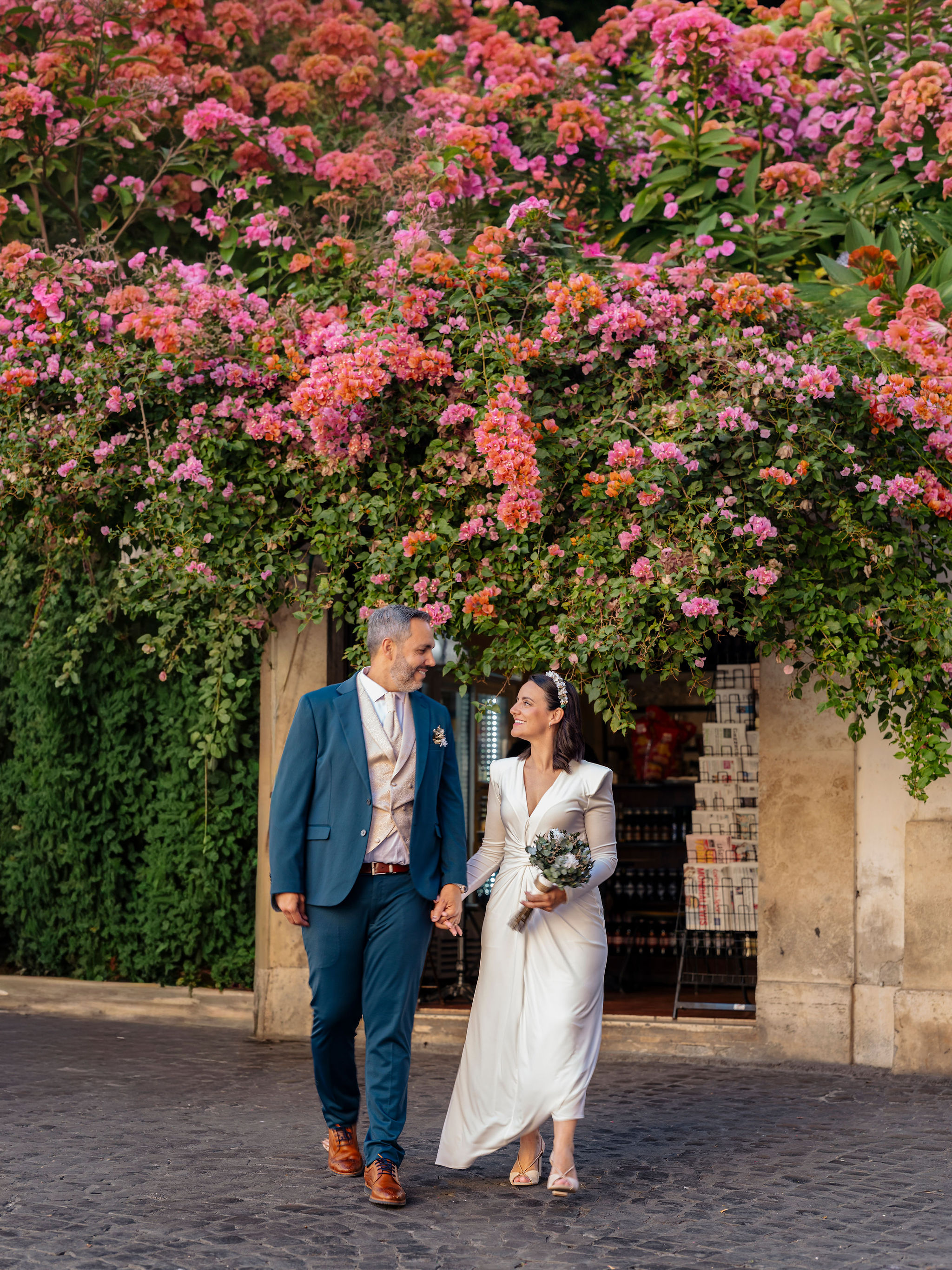
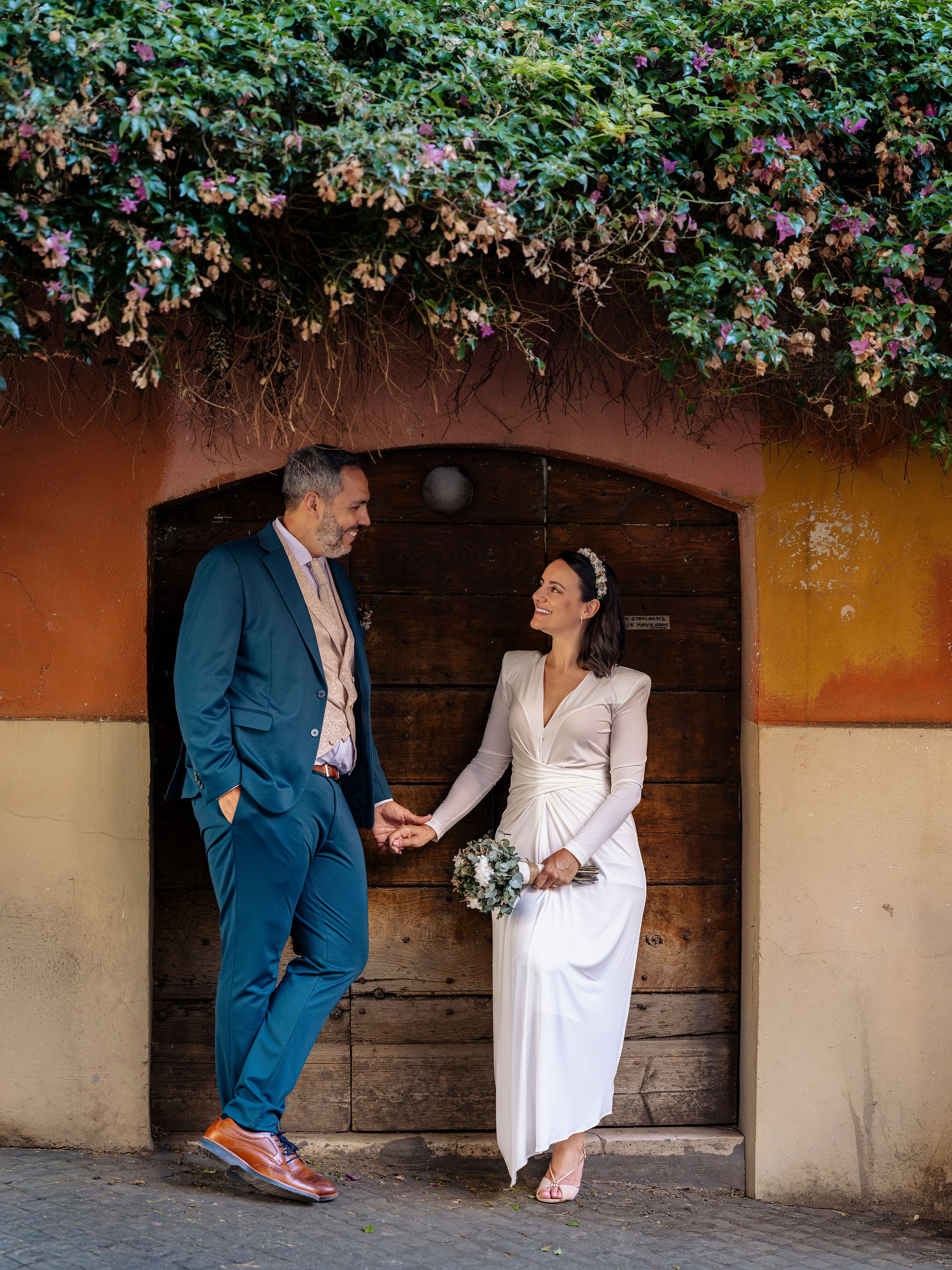
Monti is where the gallery changes register. Narrower streets, ivy-covered doorways, and far fewer landmarks in the frame push the focus away from the setting and onto the couple themselves. Walking, talking, and simply existing in a quieter street produces a different kind of image than posing in front of a monument does.
This is also, practically, where a couple tends to relax. By this point in a session, the more self-conscious energy of the opening formal portraits has usually worn off, and Monti's scale, human-sized streets rather than a monumental piazza, makes that shift easier. The images from this stretch are typically candid rather than posed: a hand reaching for another, a genuine laugh, a moment of walking rather than standing still.
Epic: The Colosseum as the Finale
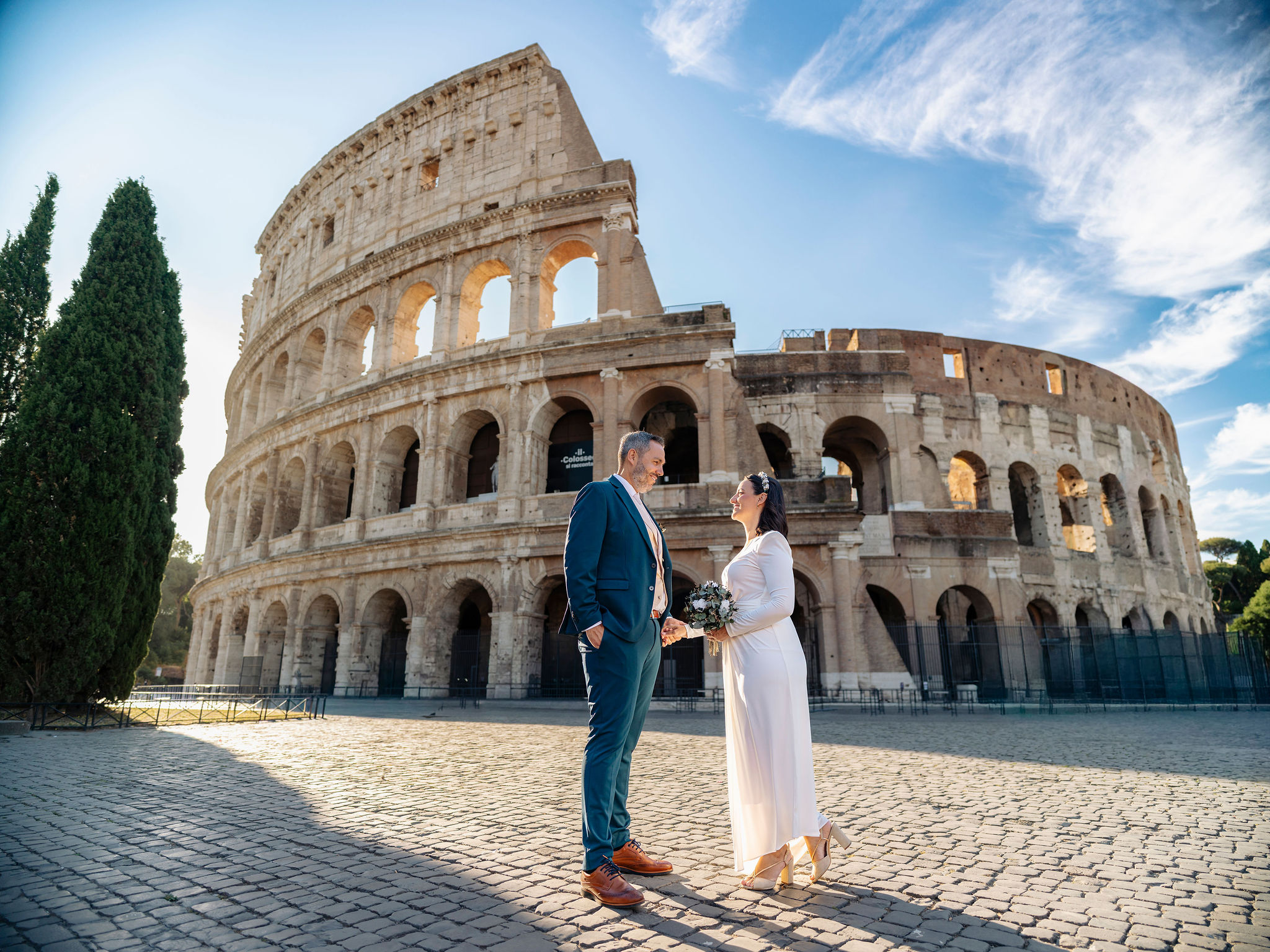
Ending a couple photoshoot in Rome at the Colosseum gives the gallery a strong close. Scale does real work here: after the intimacy of Monti, the sheer size of the amphitheater reads as a deliberate shift rather than a return to the same register as the opening. Wide shots with the couple small against the arches create a cinematic quality that a tighter, more intimate frame can't produce on its own.
This is also where the session can include a few more dynamic images, a walk toward the camera, a turn, a moment of motion rather than a held pose, since the space and the light at this hour tend to support it. A gallery that ends on an image like this tends to feel resolved, the same way a strong closing shot in a film leaves an impression the middle of the story doesn't.
Why the Order Matters
The same three locations, shot in a different sequence, would produce a different gallery, and not necessarily a better one. Starting at the Colosseum and ending at the Trevi Fountain, for instance, would front-load the most dramatic images and close on a more formal, contained note, which tends to feel like the story is winding down rather than building toward something.
Iconic to intimate to epic works because it mirrors how a couple actually moves through a morning like this: composed and slightly formal at the start, more at ease in the middle, and more expressive by the end, once nerves have worn off and the session has built some momentum.
Location-Driven Photos vs. Relationship-Driven Photos
It's worth naming the distinction directly, since it's the core idea behind this approach. A location-driven photo is one where the setting is the subject and the couple is placed inside it, valuable, but limited if it's the only kind of image in the gallery. A relationship-driven photo is one where the couple's interaction is the subject, and the setting, whatever it happens to be, supports that rather than competing with it.
The difference isn't about which photos are posed and which aren't. A relationship-driven image can still be directed. What separates the two is what the eye goes to first. In a location-driven shot, the architecture usually wins that first glance. In a relationship-driven shot, it's the couple, their hands, their expressions, the distance between them, that the eye lands on, even if the same landmark is technically visible in the frame.
A strong gallery needs both. The Trevi Fountain and Colosseum stages lean more location-driven, which is appropriate, since part of what a couple wants from Rome is proof they were actually there, in front of the buildings that make the city recognizable. Monti leans relationship-driven, and having that balance across the session is what keeps the final gallery from feeling like a set of postcards with two people standing in front of them.
How Couples Loosen Up Over a Session
Almost every couple starts a session a little stiff, aware of the camera, unsure what to do with their hands, conscious of being watched by whoever else happens to be nearby. That's normal, and it's part of why the order of locations matters as much as the locations themselves.
By the time a couple reaches the second or third stop, most of that early stiffness has faded. They've had time to get used to being photographed, the first batch of “important” formal shots is already done, and there's less pressure riding on any single frame. That shift shows up clearly in the photos themselves: looser shoulders, more genuine expressions, less awareness of the lens. Structuring a session to end on the more expressive, dynamic locations takes advantage of that natural loosening rather than fighting against it.
This is also why trying to get the most candid, relaxed images first, before a couple has settled in, tends to underperform. The comfort has to be built over the course of the morning. Planning the route with that in mind, rather than hoping it happens on its own, is a large part of what separates a gallery that feels cohesive from one that simply documents three stops on an itinerary.
Designing This for Your Own Session
This particular route, Trevi to Monti to Colosseum, is one version of the idea, not the only one. The underlying structure, open on one register, shift to something quieter, close on something bigger, can be built around a different set of locations depending on what a couple wants their gallery to include.
Because this kind of photography in Rome is built around a specific sequence and mood rather than a single fixed location, it's typically arranged as a custom experience rather than a standard package, so the route, pacing, and finale can be planned around what a couple actually wants their gallery to feel like.
Frequently Asked Questions
1. Do we need an actual elopement ceremony to do a session like this? No. This structure works equally well as elopement portraits, a post-wedding or newlywed session, or simply a couple's portrait session in Rome. What matters is the variety of settings and moods, not whether a ceremony took place that same day.
2. Can this work with different locations than Trevi, Monti, and the Colosseum? Yes. The specific locations matter less than the underlying idea, one grand opening setting, one quieter and more intimate stretch, and one large, cinematic closing location. Other combinations can follow the same structure.
3. How long does a session like this usually take? Moving between three locations with time to shoot properly at each one typically takes a few hours. The exact length depends on distances between locations and how much time is spent at each stage.
4. Does the order always have to be iconic, then intimate, then epic? It's the sequence that tends to work best for the reasons described above, easing a couple into the session and building toward a strong finish, but it can be adjusted based on a couple's energy, schedule, or preference.
5. Does this approach work for a family or friend group, not just a couple? Yes, the same underlying structure, a grand opening setting, a quieter middle stretch, and a bigger closing location, applies to a family gallery as well. The relationship-driven images in the middle simply shift from a couple's interaction to interactions between family members.
Jeff


